
From chemical dosing and mixing to pouring, expansion and cutting, every stage of slabstock foam production influences the final product. Discover how precise process control, advanced automation and dedicated technologies help manufacturers achieve consistent foam quality, reduce waste and improve production efficiency across the entire continuous production line.
July 30, 2026
How precise process control ensures consistent foam quality from chemical dosing to the finished block
Every block starts long before the foam rises
Continuous slabstock production is a dynamic chemical process where every stage influences the next. Unlike batch manufacturing, there is no opportunity to stop and restart without consequences. A small variation in the chemical formulation or in the pouring process can propagate throughout the entire block, affecting both foam quality and production efficiency.
For this reason, achieving consistent slabstock foam requires continuous monitoring of every critical variable, following the exact physical and chemical evolution of the foam—from the recipe to the finished block ready for curing. Each stage presents its own challenges, and every parameter must remain within carefully defined limits to ensure a stable and repeatable production process.
Step 1: Building the right recipe
Before any chemical reaction takes place, the metering system must deliver every component with absolute precision. Even minor fluctuations in raw material flow rates can compromise the final foam properties, making consistency difficult to achieve.
This is particularly important for critical ingredients such as TDI, methylene chloride, and water, whose chemical metering directly influences the expansion reaction. High-precision mass flow meters continuously monitor these components, allowing the system to compensate immediately for any deviation and maintain the desired formulation throughout production.
Equally important is the process control system supervising the entire line. Advanced automation platforms such as OMEGA 4.0 act as the operational brain of the plant, managing recipes while continuously monitoring chemical line pressures. Through closed-loop control, it automatically compensates for process variations in real time. By continuously comparing process parameters with target values, the system ensures that production starts—and remains—within specification, providing operators with complete visibility and control over the entire formulation.
Step 2: Mixing chemicals and creating the cellular structure
Once the chemicals enter the mixing head, attention shifts from dosing accuracy to the quality of the mixing process itself. At this stage, proper incorporation of nucleation air becomes essential for generating a uniform cellular structure.
Optimizing air mixing is essential for a uniform cellular structure. A Silicone Air Mixer nucleates air before it enters the mixing head, ensuring even dispersion within the silicone. This leads to consistent cell formation and minimizes defects like pinholes and trapped air bubbles.
When producing low-density foams, the blowing agent becomes another key process variable. Liquid CO₂ technologies such as CarDio® offer an efficient alternative to conventional blowing agents like methylene chloride, enabling cleaner production while maintaining excellent foam performance. The precise management of liquid carbon dioxide allows manufacturers to produce high-quality low-density foams with a stable process and fewer operational issues.
Step 3: Pouring the reacting foam
The moment the reacting mixture reaches the conveyor represents one of the most delicate transitions in the entire production process. Here, both the deposition method and the pressure distribution determine how the foam will expand during the following stages.
Two different deposition concepts can be adopted depending on production requirements. In Liquid Laydown, the liquid mixture is poured directly onto a plate, allowing entrapped air to escape immediately before the reaction progresses. This approach helps minimise visual defects such as pinholes while improving the surface appearance of the finished block.
Alternatively, the Trough process allows the chemical reaction to begin inside a variable trough before the foam reaches the fallplate. By controlling the initial expansion, this method promotes a more uniform horizontal distribution, making it particularly suitable for producing flatter, more geometrically stable foam blocks.
Production flexibility introduces another critical challenge. Switching from one recipe to another—whether changing foam grade, density, or colour—often generates waste if process conditions cannot be adjusted quickly enough. Systems such as LayDown Master and LayDown VariMaster allow operators to modify output and pressure on the fly, maintaining a uniform foam distribution across the conveyor width without stopping production. This significantly reduces downtime while limiting transition scrap between different formulations.
Step 4: Controlling expansion and block geometry
As the chemical reaction continues, the foam rises rapidly and expands into its final shape. At this point, maintaining the correct block geometry becomes essential not only for product quality but also for material yield.
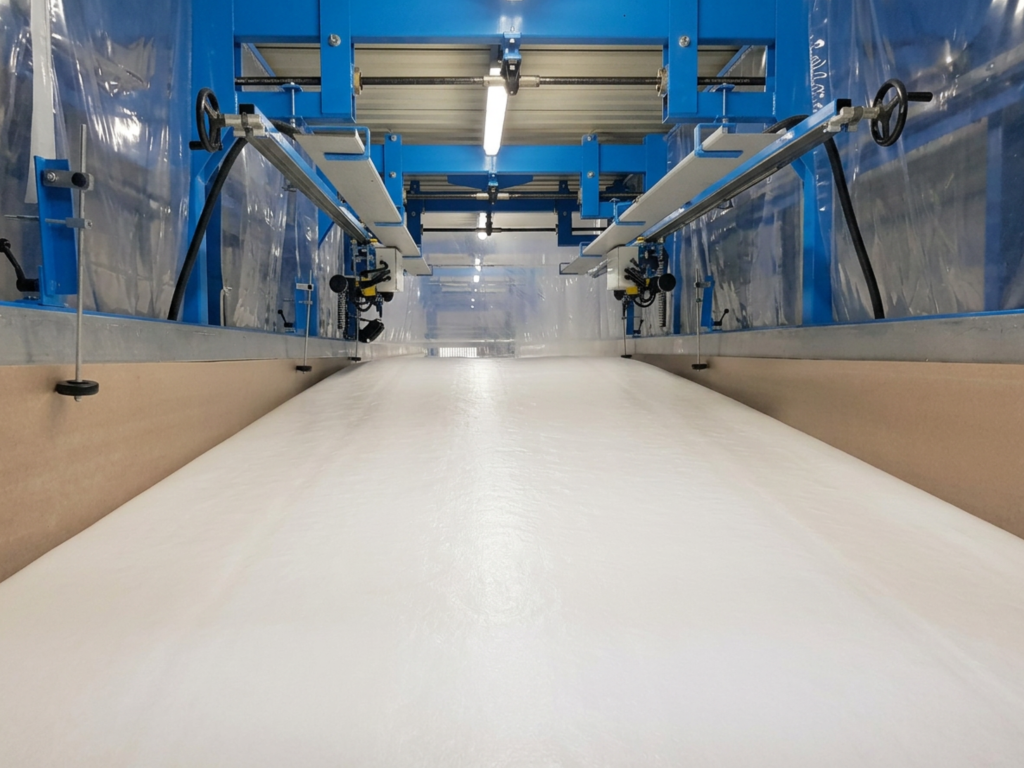
One of the main objectives is to reduce the characteristic dome that naturally forms during expansion. Technologies such as our RS system address this challenge by synchronously lifting two side films together with the expanding foam. By reducing friction along the block sides, the foam can rise more evenly, producing a flatter block with a more regular geometry. The result is higher material yield and less skin waste. Other alternative solutions include the Planiblock System, which uses a combination of skis that can be either manually or automatically adjusted to a specified height to control the shape of the foam block.
Some foam formulations require even greater process control. Viscoelastic foams and high-resilience (HR) materials exhibit different flow characteristics during expansion and therefore benefit from additional mechanical guidance. Conveyorized sidewalls, equipped with adjustable inclination angles, help direct foam growth throughout the expansion phase, maintaining consistent block dimensions while accommodating the specific behaviour of more demanding formulations.
Step 5: Cutting the finished block
Before entering the curing area, the continuous foam block must be divided into manageable sections. Although this is the final stage of the production line, cutting remains a critical process variable because dimensional accuracy directly affects downstream handling and product consistency.
An in-line cutting system as our VCO cross-cutting machine, performs precise transverse cuts while maintaining the continuous production flow. Designed to process the full range of slabstock formulations—from conventional flexible foams to ultra-soft and viscoelastic grades—it delivers clean, accurate cuts while minimising blade maintenance requirements.
Reliable cross-cutting preserves the block geometry achieved during production and prepares the foam for the curing phase without introducing additional variability.
Consistency is the result of controlling every stage
Producing consistent slabstock foam means controlling every phase of a continuous process where each variable directly influences the next. Accuracy at the chemical metering stage creates the conditions for stable mixing. A controlled pour supports uniform expansion, while dedicated shaping and cutting technologies preserve block quality until the end of the line.
By integrating these technologies into a single process under continuous supervision, manufacturers can reduce waste, improve production stability, and obtain foam blocks with consistent characteristics, time after time.

